
Electric vehicles (EV) run on electricity alone. Here’s everything else that you need to know…
By Casey Williams
As somebody who loves to travel, it is always challenging to speak the local language. Even ordering a soda has tested my knowledge of French, Spanish and Italian – occasionally at the same time. It’s much the same for those of us whose native automotive language is gasoline when electricity is becoming the dominant dialect. Fortunately, I speak EV better than French.
EV 101
A Battery Electric Vehicle (BEV) is a car that runs exclusively on batteries – no extra gas engine as in hybrids. These are cars like the Chevy Bolt, Kia EV6, and all Teslas. They employ Regenerative Braking (Regen), which replenishes electricity to the batteries when decelerating instead of releasing the kinetic energy as heat. Range is how far you can travel from fully charged to calling your boyfriend for a lift – typically a minimum of 400 kilometres, but extending to 645 kilometres for a Lucid Air.
You may have read about “one-pedal driving” and become completely discombobulated. Many EVs allow drivers to adjust the aggressiveness of this feature, but it automatically engages regen when the accelerator is released, allowing most driving without a brake pedal. Lift off the accelerator and the vehicle decelerates – easy as that.
Other terms are more familiar. Horsepower still defines work being done – a measure from the gasoline era that defines automotive performance. Torque is the twisting force that turns a vehicle’s wheels, typically higher in EVs. Unlike gas-powered vehicles, in which the engine has to rev up to produce peak power, electric motors produce power instantaneously, enabling the swift smooth acceleration that is a hallmark of EVs.
EV 201
Now, we move into advanced language. Energy potential is expressed as kilowatt-hours (kWh), or the current a battery can emit over an hour. Higher kWh means more range, acceleration or towing capacity. Batteries are bigger in trucks than in sports cars: good because bigger batteries equal more kWh. When I first drove the GM EV1 in 1996, it ran on lead-acid batteries that had been around since the Model T days. Today’s EVs employ lithium-ion batteries. That’s a high-density battery composition that was popularized in smartphones and laptop computers before migrating to EVs.
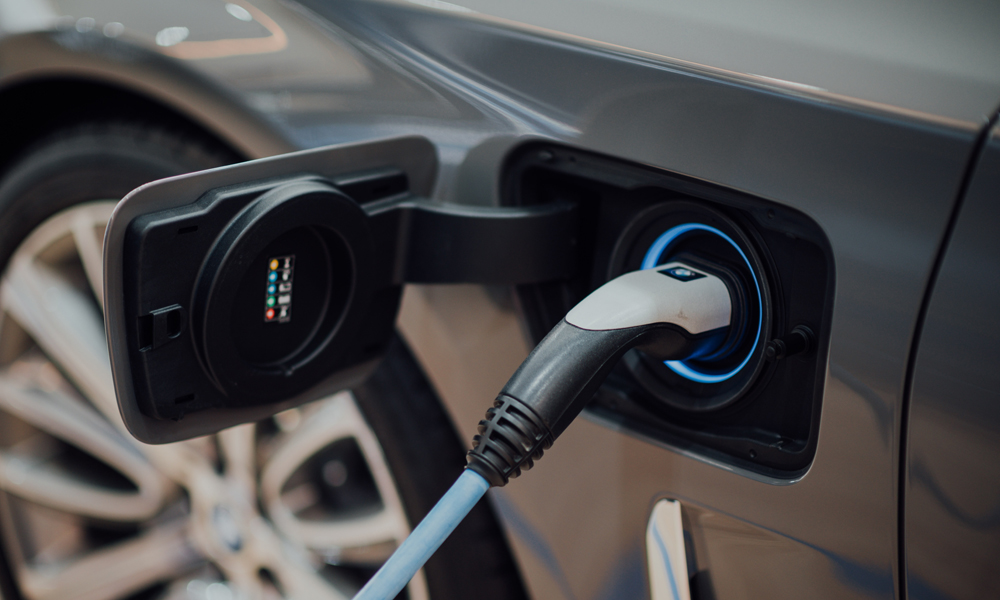
There are a few more terms you may want to learn. Three levels of chargers allow increasing speeds of charging. A Level 1 charger is essentially an EV plugged into a wall outlet. It takes days to fully recharge. Moving up to a Level 2 charger – typical for home and commercial installation – brings that time down to under 10 hours. The fastest Level 3 DC Fast Chargers can replenish a battery pack in about 30 minutes – a little more for a pickup truck like the Ford F-150 Lightning.
We’ll finish this lesson with two more words: drag coefficient. That’s not your ability to woo RuPaul, but rather a measure of a vehicle’s resistance to the wind that contributes to range, acceleration and wind noise. Take this little lesson to heart and you’ll dominate the runway, roadway and driveway in the next era of driving.
CASEY WILLIAMS is a contributing writer for Gaywheels.com. He contributes to the New York-based LGBT magazine Metrosource and the Chicago Tribune. He and his husband live in Indianapolis, where Williams contributes videos and reviews to wfyi.org, the area’s PBS/NPR station.




POST A COMMENT