
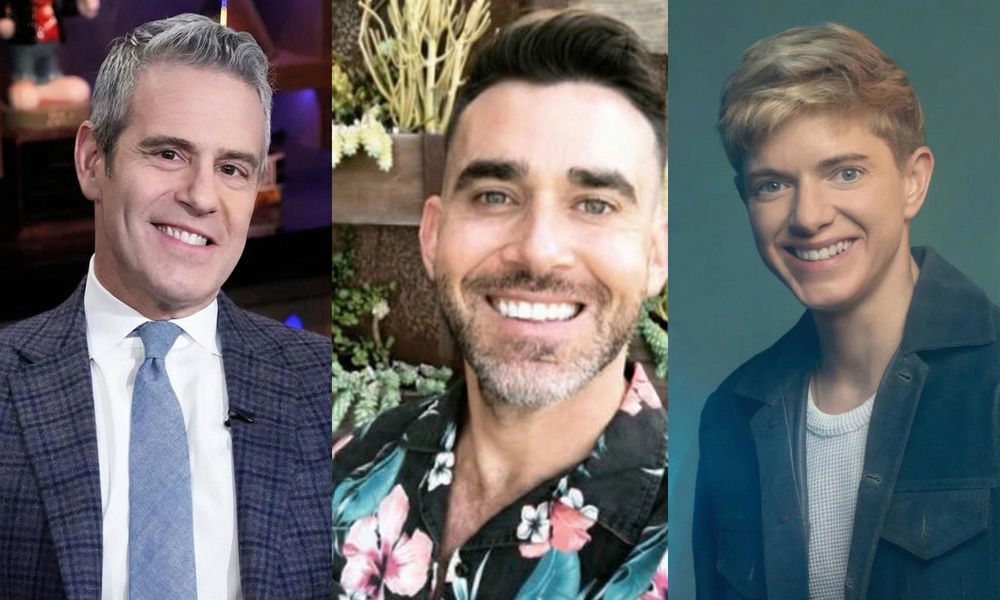
Why Andy Cohen, Jesse Tannenbaum, and Mae Martin are the most important voices in entertainment right now. Securing the future of queer representation…
I can think back to 2008, when No on 8 was unfolding in real time. Whether you were in Canada or the United States, it was impossible to avoid the images from the NOH8 Campaign by Adam Bouska and Jeff Parshley—faces taped shut, a silent but defiant refusal to accept erasure. For many of us, it was the first time queer visibility felt loud simply by existing.
I was growing up in Sudbury, Ontario then, and like many queer kids in small towns, I ran away as soon as I could. Not because I didn’t love where I came from, but because I couldn’t yet love who I was there. The culture around me was only beginning to grasp that we weren’t different, that our lives weren’t a phase or an aberration. And still, everywhere I looked—television, film, reality shows—I saw nothing that resembled me. Queer characters were tokens. Storylines were cautionary. Being visible felt dangerous.
That absence kept me away from home, and from myself, for nearly fifteen years. My story isn’t exceptional; it’s shared by countless people who learned to survive by shrinking. What is exceptional is that, after decades of progress, we are once again watching institutions quietly backpedal on inclusion. Which is why it matters—now more than ever—to pay attention to the people inside the industry who are still moving the needle forward.
These are not just entertainers. They are architects of visibility. In 2025, three stand out not because they are loud, but because their influence is undeniable.
The stakes remain high. During the 2008–09 broadcast season, only about 2.6% of series regular characters on television were LGBTQ+, and even now progress proves fragile. In 2025, GLAAD warned that roughly 41% of LGBTQ+ characters on television are unlikely to return the following year due to cancellations and shifting priorities—an alarming reminder that visibility, once gained, is never guaranteed.
Currently we see this with the cancellation of Boots on Netflix, as Heated Rivalry got picked up. In a world where both should be able to exist, only one could hold the space.
Andy Cohen (Powerhouse)
LGBTQ+ Media Representation and Television Power in 2025
When Andy Cohen debuted Watch What Happens Live in 2009, he became the first openly gay host of a U.S. late-night talk show. It wasn’t framed as activism—it was framed as inevitability. His queerness wasn’t a storyline or a provocation; it was simply present. As Cohen has said repeatedly, media only works when “everybody gets to be represented,” not as a category, but as part of the culture.
Before his on-camera success, Cohen shaped Bravo from behind the scenes, helping usher in shows like Queer Eyeand Project Runway at a time when openly queer talent was still considered a risk. Under his leadership, queer presence became normalized rather than spotlighted—woven into the fabric of the network rather than treated as a special episode.
Cohen’s advocacy has also been tangible. In 2013, he refused to co-host the Miss Universe pageant in Russia in protest of the country’s anti-gay laws, taking a public stand that reached far beyond entertainment media. In 2019, GLAAD honored him with the Vito Russo Award, recognizing his sustained contribution to LGBTQ+ visibility.
Today, as the face of Real Housewives reunions and a New Year’s Eve co-host on CNN, Cohen continues to bring queer presence into millions of homes. His power isn’t just visibility—it’s infrastructure. He is not just seen; he is embedded. And that is what makes him a powerhouse.
Jesse Tannenbaum (MVP)
Inclusive Casting, Survivor, and the Future of Reality TV
Jesse Tannenbaum does not appear on screen, but his fingerprints are everywhere.
As the lead casting director for Survivor, The Amazing Race, and Big Brother, Tannenbaum has quietly reshaped reality television from the inside. After taking over The Amazing Race casting in 2017 and Survivor in 2019, his work earned multiple Emmy nominations for Outstanding Reality Casting, including the first-ever nomination for Survivor—a rare acknowledgment of casting as creative authorship.
“I wanted to stop looking for archetypes and focus on what makes each person unique and special,” Tannenbaum has said of his approach. Under his leadership, Survivor moved away from rigid templates—the jock, the villain, the token gay contestant—and toward emotionally complex people with lived experience. That evolution coincided with CBS’s 2020 commitment that 50% of reality casts be BIPOC, beginning with Survivor 41, a season widely credited with expanding both storytelling depth and audience reach.
When CBS rolled back parts of that diversity initiative in 2025, Tannenbaum was unequivocal. “From my perspective, nothing’s changed,” he said. “I’m still shooting for having a really diverse cast because I think everybody needs to be represented.” Recent seasons reflect that stance, featuring multiple queer and nonbinary contestants whose identities are integrated naturally rather than isolated for spectacle.
What distinguishes Tannenbaum is not just who he casts, but how he articulates the work. He speaks about casting as emotional architecture, assembling a “diversified group” by asking a deceptively simple question: Who’s missing? The result has been moments rarely seen on network reality television, from queer contestants finding solidarity to players openly discussing disability and neurodivergence on air.
For queer viewers—especially those who grew up watching Survivor and wondering if there was space for them—representation in decision-making positions .
For me, that question has been personal for as long as I can remember. As a gay Canadian, Survivor has been part of my imagination since I was eleven years old—something I daydreamed about daily, even when the possibility felt purely hypothetical. For years, geography and identity made that dream feel unreachable. Now, with Canadians eligible to play and with casting that actively reflects queer lives, voices like Tannenbaum’s quietly transform fantasy into something more grounded. Not a guarantee, not a promise—but a credible sense that someone like me could one day be allowed to chase that dream without being reduced to a storyline.
Tannenbaum is the MVP because he understands that changing who gets seen fundamentally changes who believes they belong.
Mae Martin (Dark Horse)
Queer Storytelling, Nonbinary Representation, and Netflix
Mae Martin operates in the in-between spaces—between comedy and drama, music and television, certainty and self-discovery.
After co-creating and starring in Feel Good, widely regarded as one of the strongest depictions of nonbinary identity on television, Martin could have stayed safely within that lane. The series resonated because it refused to reduce its protagonist to a lesson or a symbol. As one critic noted, it portrayed a nonbinary character as fully human—messy, funny, insecure, and evolving. Martin has spoken openly about still “working it out” in real time, allowing uncertainty to exist onscreen rather than forcing resolution.
In 2025, Martin expanded their creative reach with Netflix’s Wayward, serving as creator, writer, and star. The series features a trans character whose gender is understood through relationships and behavior rather than exposition, a choice Martin has described as deliberately resisting the urge to turn identity into a plot device.
Alongside their screen work, Martin released their debut album I’m A TV, a project rooted in vulnerability rather than branding. Calling themselves a “chronic oversharer,” Martin has said that music offered a way to tell the truth without the pressure of landing a punchline. Across stand-up, television, and music, the throughline is honesty without spectacle.
What makes Martin a dark horse is their refusal to be easily legible. They do not flatten their identity for comfort, nor do they perform it for approval. For younger queer audiences, Mae Martin represents permission: to be unfinished, to evolve, and to exist without explanation—and still be seen.
Where Visibility Actually Gets Built
Visibility doesn’t arrive all at once. It’s built quietly—through decisions made behind cameras, through stories allowed to be complicated, through people in power who understand that inclusion is not a moment, but a practice.
Andy Cohen, Jesse Tannenbaum, and Mae Martin operate in very different corners of entertainment, yet their impact converges in the same place: possibility. Not the kind that promises outcomes, but the kind that opens doors, widens frames, and makes room for lives that once felt unspeakable, and quite frankly, still do.
For those of us who ran away to survive and are still finding our way back, that kind of visibility doesn’t just reflect who we are. It helps shape who we’re allowed to become, these cornerstones of queerness, they definitely helped me. In a community that shouldn’t still be in survivor mode, these are trailblazers, yes, even in 2025.
POST A COMMENT